Why Late-Night Cravings Feels Hard to Control
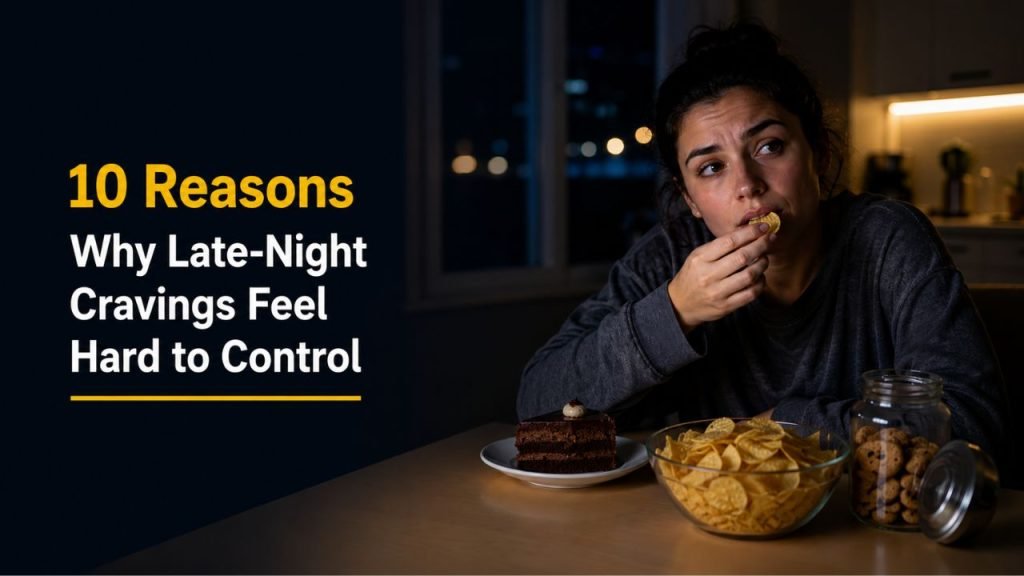
Almost everyone has experienced it — the kitchen is closed, dinner was hours ago, you are not genuinely hungry, and yet something pulls you toward the pantry or refrigerator with an urgency that feels completely disproportionate to any real physical need. Late-night cravings are one of the most universally frustrating experiences in the entire landscape of eating behavior, and the reason they feel so impossible to resist compared to daytime hunger is not a matter of willpower or discipline — it is a matter of biology, neurochemistry, hormonal rhythms, and the specific ways the brain’s reward circuitry behaves differently after dark.
10 Reasons for Why Late-Night Cravings Feel Hard to Control :
1. Your hunger hormones shift dramatically in the evening
Ghrelin — the hormone that signals hunger — naturally rises in the evening as part of the circadian rhythm, while leptin — the hormone that signals fullness and satiety — decreases, creating a hormonal environment that makes food feel more appealing and satisfaction from eating harder to achieve at night than at any other point in the day. This hormonal shift happens regardless of how much you ate during the day and is amplified significantly by sleep deprivation, stress, and irregular eating patterns that destabilize the hormonal rhythm further.
2. Your brain’s reward system becomes more active at night
Research using brain imaging has shown that the reward centers of the brain — particularly the nucleus accumbens, which drives dopamine-mediated pleasure-seeking behavior — show heightened activation in response to food cues in the evening compared to the morning, meaning that the same food looks, smells, and sounds more appealing at 10pm than it does at 10am through a purely neurological mechanism.
3. You have not eaten enough during the day
One of the most consistent patterns in people who struggle with nighttime eating is chronic undereating during the day — skipping breakfast, eating a small lunch, restricting calories consciously or unconsciously — and then experiencing an escalating hunger drive in the evening that reflects the caloric and nutritional debt accumulated over the preceding hours. The body has a caloric need that will be met one way or another, and when daytime eating is insufficient, the evening craving is not a failure of willpower but a physiological correction that the body is enforcing through increasingly powerful hunger signals.
4. Stress and emotional states drive food-seeking behavior at night
The evening is when the accumulated stress, emotional weight, and unprocessed experiences of the day land most heavily, and food — particularly calorie-dense, palatable food — activates the same dopamine and opioid reward pathways that the brain uses to seek relief from discomfort and emotional pain. Cortisol from unmanaged daily stress directly stimulates appetite and specifically increases cravings for sugar and fat, which are the foods that most reliably and rapidly activate the brain’s reward and calming circuitry.
5. You are using food as the primary wind-down tool
Most people have never developed a genuine repertoire of non-food relaxation and decompression activities, which means that the transition from the demands of the day to the rest of the evening gets managed almost entirely through eating — and the brain learns this association so thoroughly that relaxation and food become neurologically linked in a way that makes the desire for food automatic whenever the evening wind-down begins.
6. Sleep deprivation amplifies cravings for high-calorie foods specifically
Insufficient sleep does not just increase general hunger — it specifically and disproportionately increases cravings for calorie-dense, high-sugar, and high-fat foods through its effects on the endocannabinoid system, which is the same neurological system activated by cannabis that produces the munchies effect. Studies from the University of Chicago have shown that sleep-deprived people experience significantly stronger cravings for cookies, chips, candy, and fast food compared to well-rested individuals, even when caloric intake has been identical.
7. Your blood sugar has dropped after an evening insulin spike
A dinner high in refined carbohydrates — white rice, pasta, bread, sugary sauces — produces a large insulin spike that drives blood sugar down rapidly in the hours after eating, and this blood sugar drop triggers a reactive hunger that arrives two to three hours after dinner as a genuine physiological signal rather than a psychological craving. This cycle of spike and crash means that a high-carbohydrate dinner virtually guarantees a late-night hunger signal regardless of how large the meal was, because the hunger is being driven by blood sugar instability rather than actual caloric insufficiency.
8. The absence of daytime distractions removes the buffer against food thoughts
During the day, work, social interaction, physical activity, and cognitive demands occupy enough mental bandwidth that food cravings either do not arise or are easily pushed aside by competing priorities. In the evening this distraction buffer disappears, and the quiet, unstructured time that follows creates the mental space for food thoughts to surface and amplify without competition.
9. You have conditioned your brain to expect food at night
The brain is a pattern-recognition and habit-formation machine, and if you have eaten in the evening consistently for months or years, the neural pathway connecting evening time with food consumption is now deeply established and fires automatically regardless of hunger level. This conditioned craving is not driven by nutrition, hunger hormones, or blood sugar — it is a learned expectation that the brain enforces through craving signals the same way it enforces any other deeply ingrained habit.
10. The foods available at night are specifically engineered to be irresistible
Most late-night food options — snack foods, chips, chocolate, ice cream, cereals, takeaway — are designed by food scientists to hit the precise combination of sugar, fat, salt, and texture that produces the strongest possible dopamine response and the weakest possible satiety signal, meaning that these foods are specifically engineered to override the brain’s normal stop-eating mechanisms.
10 Ways to Control Late-Night Cravings :
1. Eat a protein and fat-rich dinner that genuinely satisfies
The most reliable single intervention for reducing late-night cravings is ensuring that dinner contains sufficient protein — at least 25 to 35 grams — and healthy fat that slows digestion and maintains satiety hormones at levels that do not trigger reactive hunger two hours later. Meals built around eggs, fish, chicken, lentils, or legumes combined with vegetables and a source of healthy fat like olive oil, avocado, or nuts digest slowly enough to maintain fullness well into the evening without the blood sugar crash that carbohydrate-heavy dinners produce.
2. Eat enough during the day and never skip meals
Addressing night cravings starts at breakfast — eating sufficient food at consistent intervals throughout the day prevents the caloric and nutritional debt that the body attempts to correct through powerful evening hunger signals. Breakfast containing protein and fiber, a substantial lunch, and a mid-afternoon snack if needed keeps blood sugar stable, maintains satiety hormones within their functional range, and arrives at dinner without the accumulated hunger that makes post-dinner restraint almost impossible.
3. Create a definitive kitchen closed time and stick to it
Establishing a non-negotiable cut-off time for eating — say 8pm or two hours before bed — and treating it as a firm boundary rather than a flexible guideline removes the repeated decision-making that depletes willpower and allows craving resistance to erode gradually over the course of the evening. Decision fatigue is a real and well-documented psychological phenomenon, and every time you decide not to eat something you are drawing on a finite resource — having a rule that eliminates the decision entirely preserves that resource for situations where you genuinely need it.
4. Brush your teeth immediately after your last meal
Brushing teeth and using mouthwash immediately after the last meal of the evening creates both a psychological and physical barrier to further eating — the mint sensation makes food taste unpleasant, the act of brushing signals to the brain that eating is finished for the day, and the social norm against eating after brushing provides an additional layer of behavioral reinforcement. This technique is so reliably effective in behavioral nutrition research that it is now commonly recommended by dietitians as a practical craving management strategy rather than just a dental hygiene practice.
5. Drink water or herbal tea when a craving arrives
Mild dehydration produces physical sensations that the brain frequently misinterprets as hunger, and the evening is a common time for mild dehydration to develop because most people front-load their fluid intake earlier in the day. Drinking a full glass of water or a cup of warm herbal tea — chamomile, peppermint, or ginger are particularly effective — when a craving appears addresses potential dehydration, occupies the hands and mouth in a way that partially satisfies the oral component of the craving.
6. Identify and address the emotional trigger behind the craving
Before acting on a late-night craving, pausing for 60 seconds to honestly identify what preceded it — a stressful conversation, a feeling of loneliness or boredom, anxiety about tomorrow, or simple fatigue — separates the emotional need from the food response and creates the opportunity to address the actual underlying state rather than masking it with eating. Keeping a simple craving journal for two weeks that notes the time, the craving, and what was happening emotionally beforehand reveals patterns that make the emotional drivers of nighttime eating impossible to ignore.
7. Replace evening eating with a genuine wind-down ritual
Building a consistent and genuinely enjoyable evening routine that does not involve food gives the brain an alternative reward pathway to associate with the transition from day to rest, gradually weakening the conditioned association between evening relaxation and eating that drives habitual late-night snacking. The routine works best when it involves something that genuinely activates the parasympathetic nervous system — a warm shower, gentle stretching, reading a physical book, journaling, or light music — rather than passive activities like television watching that leave the mind available to focus on food thoughts.
8. Prioritize sleep as a craving management strategy
Because sleep deprivation is one of the most powerful amplifiers of late-night food cravings through its effects on ghrelin, leptin, and the endocannabinoid system, going to bed earlier and improving sleep quality is a direct craving reduction intervention rather than simply a general health recommendation. People who extend their sleep from six to eight hours consistently report reduced evening hunger, less intense cravings for junk food, and improved ability to make food choices aligned with their intentions — all without any other dietary change.
9. Keep trigger foods out of the house entirely
Willpower is a limited resource that depletes over the course of the day, and relying on it to resist foods that are physically present in the kitchen at 10pm — after a full day of decisions, demands, and self-regulation — is a strategy that will fail consistently regardless of motivation. The most effective craving management strategy for specific trigger foods is not developing the willpower to resist them but removing the need for willpower by ensuring they are not present in the home environment.
10. Manage daytime stress to reduce evening cortisol-driven cravings
Because cortisol from accumulated daily stress is one of the primary hormonal drivers of evening cravings for sugar and fat, investing in consistent daily stress management during the day reduces the cortisol load that arrives in the evening and demands relief through food. A 10-minute breathing practice in the afternoon, a short walk after work, or any consistent daily activity that genuinely lowers the nervous system’s stress activation level reduces the neurochemical pressure behind evening cravings in a way that no amount of evening discipline can achieve on its own.
Disclaimer:
This article is for informational purposes only and is not a substitute for professional medical advice, diagnosis, or treatment. If you are experiencing compulsive eating behaviors, binge eating, or disordered eating patterns, please consult a qualified healthcare provider or registered dietitian. Always seek guidance from a licensed medical professional for any personal health concerns.