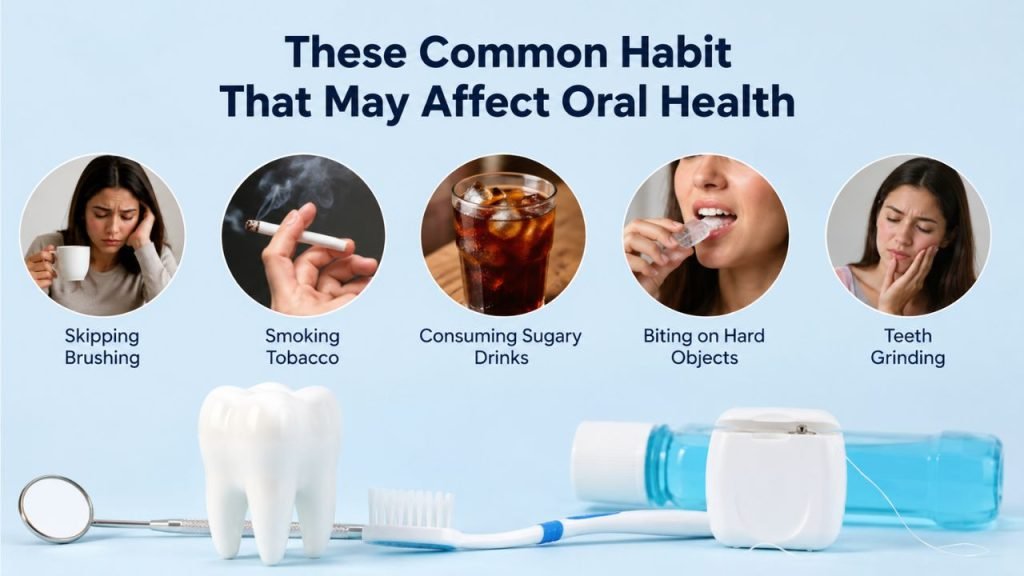
These Common Habit That May Affect Oral Health
Most people think about their oral health only when something hurts — a toothache, bleeding gums, or a sensitivity that forces attention — never considering that the daily habits running quietly in the background of their normal routine have been steadily working against their teeth and gums for years before any obvious symptom appears. The mouth is one of the most microbiologically complex environments in the human body, housing over 700 species of bacteria whose balance between harmful and beneficial populations is determined almost entirely by the daily habits of eating, drinking, cleaning, and lifestyle that most people have never critically examined. Oral health is also far more connected to systemic health than most people realize — the same bacterial inflammation driving gum disease has been found in arterial plaques.
20 Common Daily Habits That May Be Quietly Affecting Your Oral Health
1. Brushing your teeth too hard
Aggressive brushing with too much pressure or a hard-bristled toothbrush erodes tooth enamel — the irreplaceable protective outer layer of the tooth — and strips the gum tissue away from the tooth root in a process called gingival recession that exposes the sensitive dentine beneath. Once enamel is worn and gums have receded, neither reverses naturally, making the damage permanent and progressive with every subsequent hard brushing session.
2. Not brushing before bed
The mouth is driest during sleep — saliva production drops significantly overnight — and without the flushing and antimicrobial action of saliva, any food debris and plaque bacteria left on tooth surfaces from the day ferment undisturbed for six to eight hours, producing acids that demineralize enamel and create the conditions for rapid cavity development. Going to bed without brushing even occasionally allows this acid attack to occur at its most damaging — in a dry environment with no saliva buffering — making nighttime brushing the single most important brushing session of the day.
3. Consuming sugary and acidic drinks throughout the day
Every sip of a sugary or acidic drink — soda, juice, sports drinks, flavored water, energy drinks — delivers a pulse of acid or fermentable sugar to the tooth surface that triggers an enamel demineralization event lasting approximately 20 to 40 minutes. Sipping these drinks over hours rather than consuming them in one sitting multiplies the number of acid attacks the teeth endure throughout the day, producing a cumulative enamel erosion that is far more damaging than the same volume consumed quickly.
4. Skipping flossing because brushing feels sufficient
Toothbrush bristles physically cannot reach the contact points between teeth where approximately 40 percent of each tooth surface lies, and the plaque that accumulates in these interdental spaces is the primary driver of the interproximal cavities and gum disease that develop between teeth rather than on their visible surfaces. Skipping flossing leaves nearly half of each tooth consistently uncleaned regardless of how thoroughly or how frequently brushing is performed, creating protected bacterial environments that brush-only routines can never address.
5. Mouth breathing habitually
Chronic mouth breathing — whether from nasal congestion, habit, or anatomical factors — produces a persistently dry oral environment by bypassing the nose’s humidification function and evaporating saliva from the mouth continuously throughout the day and night. Saliva is the mouth’s primary defense against tooth decay and gum disease — it neutralizes acids, remineralizes enamel, controls bacterial populations, and physically washes away food debris — and when its volume is chronically reduced by mouth breathing, all of these protective functions are impaired simultaneously.
6. Grinding or clenching teeth
Bruxism — the unconscious grinding or clenching of teeth during sleep or during periods of concentration and stress — exerts forces on the teeth that can be ten times greater than normal chewing forces, producing enamel fractures, tooth flattening, cracked cusps, jaw joint pain, and the gradual shortening of teeth that gives severe bruxers their characteristic worn dental appearance. Most people who grind their teeth are entirely unaware they do so until a partner reports the noise or a dentist identifies the characteristic wear patterns at a checkup.
7. Using teeth as tools
Opening packaging, tearing tags off clothing, biting fingernails, holding objects in the mouth, or cracking nuts with the teeth applies lateral and shear forces to tooth structure that it is not designed to withstand, producing micro-fractures in enamel, cracked cusps, and in some cases complete tooth fractures that require extensive restorative treatment. Every time a tooth is used as a tool it absorbs a mechanical stress event that it does not fully recover from, and the cumulative effect of years of this habit is enamel that is micro-fractured throughout, significantly increasing sensitivity, fracture risk, and the likelihood of needing crowns or extractions.
8. Smoking and tobacco use in any form
Tobacco in all its forms — cigarettes, cigars, pipes, chewing tobacco, and electronic cigarettes — is among the most comprehensively damaging substances to oral health, producing gum disease through its suppression of the immune response in gum tissue, oral cancer through its carcinogenic compounds, tooth staining through tar and nicotine deposits, dry mouth through its reduction of salivary flow, and impaired wound healing that makes dental procedures and gum disease treatment less effective. Smokers are twice as likely to develop gum disease as non-smokers, and the gum disease they develop progresses faster, responds less well to treatment, and produces more severe bone loss than the same disease in non-smokers.
9. Eating a diet high in sugar and refined carbohydrates
The bacteria in dental plaque — particularly Streptococcus mutans — ferment dietary sugars and refined carbohydrates to produce lactic acid that directly dissolves the calcium phosphate mineral structure of tooth enamel, and this process begins within seconds of sugar reaching the tooth surface and continues for 20 to 40 minutes after each exposure. A diet built around frequent sugar consumption — whether from obvious sources like sweets and desserts or less obvious ones like white bread, crackers, cereals, and flavored yogurts — maintains teeth in a near-continuous state of acid attack that progressive demineralizes enamel and creates the conditions for cavity formation.
10. Ignoring dry mouth without addressing its cause
Dry mouth — whether caused by medication side effects, mouth breathing, dehydration, autoimmune conditions, or radiation therapy — creates the most tooth-decay-friendly oral environment possible by removing saliva’s acid-neutralizing, remineralizing, and antibacterial functions simultaneously. Many medications including antihistamines, antidepressants, blood pressure medications, and diuretics list dry mouth as a side effect, and the dental consequences of medication-induced dry mouth in long-term users are severe and often dramatically underappreciated by both patients and prescribing physicians.
11. Drinking coffee or tea and not rinsing afterward
Coffee and tea are among the most potent tooth-staining beverages consumed regularly because their tannins and chromogens bind to the acquired pellicle — the protein film that coats teeth — and produce extrinsic staining that progressively darkens teeth with every cup consumed without subsequent rinsing. Beyond staining, coffee is mildly acidic and the combination of caffeine-induced reduced salivary flow and acid contact produces a low-level enamel challenge with every cup.
12. Not replacing your toothbrush regularly
A toothbrush that has been used for more than three to four months has bristles that are frayed, splayed, and physically incapable of removing plaque effectively from tooth surfaces and along the gumline — and continuing to use it provides a false sense of dental hygiene compliance while leaving the teeth increasingly poorly cleaned. Worn toothbrushes are also repositories of accumulated bacteria, and the biofilm that develops on old brush heads is transferred to the mouth with every use.
13. Consuming ice or very hard foods habitually
Chewing ice, hard candies, popcorn kernels, pens, or other very hard objects applies sudden compressive and shear forces to tooth enamel and underlying dentine that exceed the material strength of the tooth in ways that produce micro-fractures, cracked cusps, and in severe cases complete crown fractures that require extraction. The thermal shock of ice chewing is an additional insult — the rapid temperature change causes the enamel and dentine to expand and contract at different rates, creating internal stress that propagates existing micro-fractures.
14. Not drinking enough water throughout the day
Water is the most tooth-friendly beverage available — it contains no acids, no sugars, and no chromogens, and its consistent presence in the mouth dilutes acids from food and beverages, washes away food debris, maintains salivary hydration, and in the case of fluoridated tap water delivers topical fluoride to the tooth surface with every sip. Chronic mild dehydration reduces saliva production and leaves teeth without this constant protective flushing action for extended periods, increasing enamel vulnerability to whatever acids and bacteria are present.
15. Rinsing with mouthwash immediately after brushing
Many people use mouthwash immediately after brushing as a final step, not realizing that this washes away the concentrated fluoride from toothpaste that needs to remain on tooth surfaces for as long as possible to deliver its remineralizing benefit. Clinical guidelines from dental organizations now recommend not rinsing after brushing — or rinsing only with a small amount of water rather than mouthwash — to allow the fluoride residue to continue working for at least 30 minutes after brushing.
16. Skipping regular dental checkups
Dental problems including cavities, gum disease, and oral cancer are significantly cheaper, simpler, and less painful to treat at their earliest detectable stage than when they have progressed to the point of producing symptoms — and the only way to detect them at an early stage is through regular professional examination. Many people avoid dental visits until pain forces them to attend, at which point the relatively minor intervention that would have resolved the problem six months earlier has become a more complex and expensive procedure.
17. Eating frequently without giving teeth recovery time
Every eating occasion — regardless of what is consumed — creates a temporary drop in oral pH as the bacteria in plaque metabolize available carbohydrates and produce acid. The mouth needs approximately 30 to 40 minutes after each eating occasion to return to a neutral pH through saliva buffering and remineralization, and frequent snacking — eating every one to two hours throughout the day — prevents this recovery from ever occurring, keeping teeth in a near-continuous low pH environment.
18. Using whitening products too frequently
Over-the-counter whitening strips, gels, and trays use hydrogen peroxide or carbamide peroxide to bleach tooth chromogens, and while used correctly at recommended frequencies they are safe for most people, overuse produces chemical erosion of the enamel surface, increased dentine exposure, heightened sensitivity, and gum irritation that is often irreversible once established. Many people who are unsatisfied with initial results increase frequency or concentration beyond recommended levels, not understanding that enamel erosion from whitening is cumulative and that the sensitivity and transparency that signal overuse reflect real structural damage that whitening is causing to the outer tooth layer.
19. Not cleaning the tongue daily
The tongue’s surface is covered in papillae — small projections that create an enormous surface area for bacterial colonization — and the bacterial biofilm that accumulates on the tongue is a primary source of the volatile sulfur compounds responsible for bad breath, as well as a reservoir of harmful bacteria that are continuously transferred to the teeth and gums with every swallow. Most people brush their teeth thoroughly while completely ignoring the tongue, leaving the largest single bacterial reservoir in the mouth entirely unaddressed by their oral hygiene routine.
20. Snacking on acidic fruits or vinegar-based foods and brushing immediately after
Acidic foods including citrus fruits, tomatoes, vinegar, and fermented foods temporarily soften the enamel surface through demineralization, and brushing within 30 minutes of consuming them applies abrasive force to enamel that is in its most vulnerable and softest state — accelerating the erosion that the acid began in a way that healthy enamel would have resisted. The correct approach is to rinse with water immediately after acidic food to dilute and clear the acid, and then wait at least 30 minutes for saliva to remineralizers and reharden the enamel before brushing.
Disclaimer:
This article is for informational purposes only and is not a substitute for professional dental or medical advice, diagnosis, or treatment. If you are experiencing dental pain, bleeding gums, sensitivity, or any other oral health concern, please consult a qualified dentist or oral health professional promptly. Always seek guidance from a licensed dental professional for any personal oral health concerns and maintain regular dental checkups regardless of the absence of symptoms.