The Daily Habit That May Be Causing Hair Loss
Most people who notice their hair thinning or shedding more than usual immediately assume it is genetic, hormonal, or simply inevitable — never once considering that the habits they repeat every single day without a second thought could be the primary driver behind what they are losing. Hair loss is rarely caused by one dramatic event; it is almost always the result of a slow, cumulative assault on the hair follicle from multiple directions simultaneously — nutritional gaps, mechanical stress, hormonal disruption, and scalp damage that builds quietly over months before the thinning becomes visible enough to cause alarm. The hair follicle is one of the most metabolically active structures in the human body, requiring a consistent supply of nutrients, circulation, and hormonal balance to complete its growth cycle properly.
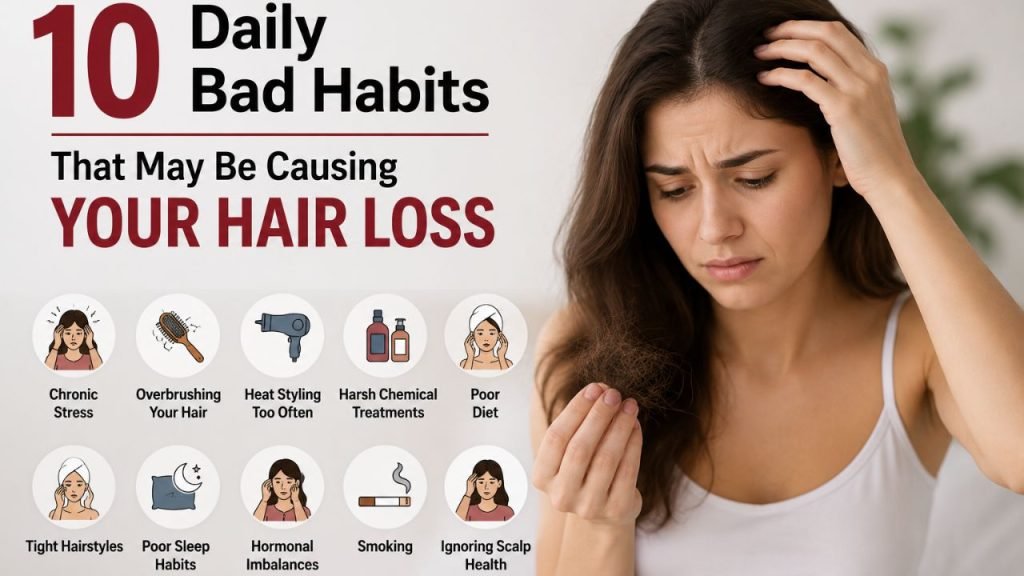
10 Daily Bad Habits That May Be Causing Your Hair Loss :
1. Wearing your hair in tight hairstyles every day
Ponytails, buns, braids, and extensions worn consistently tight exert constant mechanical tension on the hair follicles along the hairline and temples, gradually damaging the follicle root and triggering a specific type of hair loss called traction alopecia. The damage accumulates slowly enough that most people do not connect their thinning edges to a hairstyle they have been wearing for years. Once follicles are repeatedly traumatized, the hair in those areas becomes progressively thinner and in some cases the damage becomes permanent if the tension is not relieved early enough.
2. Washing your hair with very hot water
Hot water strips the scalp of its natural sebum barrier, the protective oil layer that keeps the scalp moisturized, balanced, and healthy enough to support strong follicle activity. A dry, irritated scalp creates a hostile environment for hair growth and increases inflammation around the follicle base, which directly interferes with the hair growth cycle. Switching to lukewarm water for washing and finishing with a cool rinse is one of the simplest changes that improves scalp health noticeably within a few weeks.
3. Aggressive towel drying after washing
Wet hair is at its most structurally vulnerable state — the protein bonds within each strand are loosened by water and the hair stretches and breaks far more easily than when dry. Vigorously rubbing wet hair with a towel creates friction that snaps strands mid-shaft, roughens the cuticle, and pulls hair from the follicle at a stage when it is least able to resist the force. Gently squeezing water out with a soft microfiber towel or cotton t-shirt rather than rubbing produces an immediate reduction in mechanical breakage.
4. Chronic psychological stress without any management
Prolonged stress elevates cortisol levels in the body, and high cortisol directly disrupts the hair growth cycle by pushing a large number of follicles simultaneously into their resting phase — a condition called telogen effluvium that produces diffuse shedding across the entire scalp rather than in one area. The shedding typically begins two to three months after the stressful period, which is why most people never connect the hair loss to the stress event that caused it.
5. Skipping meals or eating an unbalanced diet daily
Hair follicles are among the first structures in the body to be deprioritized when nutrition is insufficient, because the body redirects available nutrients toward essential organs and functions first. Chronically low intake of protein, iron, zinc, biotin, and B vitamins — all required for normal hair growth — causes follicles to produce thinner, weaker strands and eventually to stop producing hair altogether until nutritional status improves.
6. Overstyling with heat tools daily
Daily use of flat irons, curling wands, and blow dryers at high temperatures degrades the keratin protein structure of the hair shaft, producing porosity, fragility, and breakage that over time creates the appearance of thinning even when the follicle itself is still active. The damage is cumulative — each high-heat styling session breaks more protein bonds than the previous one — and the hair becomes progressively weaker, thinner, and more prone to snapping before it can reach any meaningful length.
7. Not protecting your scalp from sun exposure
The scalp is skin, and chronic UV exposure damages it in exactly the same way it damages facial skin — breaking down collagen, triggering inflammation, and impairing the cellular function of the follicle base over time. People who spend significant time outdoors with their scalp unprotected, particularly those with thinning hair or a natural part that exposes the scalp directly to sun, accumulate UV damage that contributes to follicle miniaturization and reduced hair density over years.
8. Sleeping on a rough cotton pillowcase
Spending six to eight hours with your hair against a rough cotton surface creates significant friction that tangles, roughens, and breaks hair strands throughout the night — and for people who move during sleep, the mechanical stress on the hair is both prolonged and repeated every single night. Silk or satin pillowcases reduce this friction dramatically and allow hair to move smoothly against the surface rather than catching and breaking.
9. Scratching or picking at the scalp habitually
Many people habitually scratch their scalp in response to mild itching, dryness, or simply as an unconscious stress behavior, and repeated scratching with fingernails creates micro-trauma in the scalp skin that triggers inflammation around the follicle base. Chronic low-level inflammation at the follicle site disrupts the hair growth cycle, can introduce bacteria that cause scalp infections, and over time produces scar tissue that permanently impairs follicle function in repeatedly traumatized areas.
10. Consuming excess sugar and processed foods daily
A diet consistently high in refined sugar and ultra-processed foods drives chronic insulin spikes, systemic inflammation, and oxidative stress — three conditions that directly impair follicle health and accelerate the miniaturization of hair follicles that leads to thinning. High sugar intake also depletes the B vitamins and zinc that the follicle needs for its growth cycle, creating nutritional deficiencies even in people eating what appears to be a sufficient quantity of food.
10 Things You Can Do Daily to Control Hair Loss :
1. Massage your scalp for five minutes every day
Daily scalp massage using the fingertips in slow, firm circular movements increases blood circulation to the follicle base, delivering more oxygen and nutrients to the cells responsible for hair production. A study published in a dermatology journal found that four minutes of daily scalp massage over 24 weeks produced measurable increases in hair thickness. Done consistently, it is one of the simplest and most evidence-supported daily habits for improving follicle health and stimulating regrowth.
2. Eat enough protein at every meal
Hair is made almost entirely of keratin, a protein, and without sufficient dietary protein the body simply does not have the raw material to build new hair strands. Most adults need between 0.8 and 1.2 grams of protein per kilogram of body weight daily, and people who are losing hair often discover they are significantly under this threshold when they actually track their intake. Eggs, lentils, chicken, fish, Greek yogurt, and cottage cheese are all excellent sources that are easy to incorporate into regular meals.
3. Take your iron and ferritin levels seriously
Iron deficiency is one of the single most common reversible causes of hair loss, particularly in women, and ferritin — the stored form of iron — is the most relevant measure because it reflects the body’s iron reserves rather than just circulating levels. Many women have ferritin levels that fall within the technically normal laboratory range but are far too low to support optimal hair growth, and increasing ferritin through dietary iron or supplementation consistently produces hair regrowth in these cases. Red meat, spinach, lentils, pumpkin seeds, and fortified cereals are among the best dietary sources of iron for hair health.
4. Switch to a gentle, sulfate-free shampoo
Sulfates are the harsh detergents in most commercial shampoos that produce rich lather but strip the scalp of its natural oil barrier and disrupt the scalp microbiome — the community of microorganisms that maintain scalp health and reduce inflammation. A dry, stripped, inflamed scalp is a poor environment for hair growth, and switching to a gentle sulfate-free formula allows the scalp’s natural protective mechanisms to function properly. Most people notice reduced scalp dryness, less itching, and improved hair texture within two to three weeks of making this switch.
5. Apply rosemary oil to your scalp regularly
Rosemary oil has emerged as one of the most evidence-backed natural interventions for hair loss, with a 2015 clinical trial finding it performed comparably to minoxidil — the most widely used pharmaceutical hair loss treatment — for androgenetic hair loss after six months of use. It works by improving scalp circulation and inhibiting the DHT-related follicle shrinkage that drives the most common type of hair thinning. Diluting a few drops in a carrier oil like coconut or jojoba and massaging it into the scalp two to three times per week is the approach most consistent with the research.
6. Manage stress through a non-negotiable daily practice
Because stress-driven cortisol elevation is one of the primary hormonal drivers of hair loss, reducing it is not optional if hair recovery is the goal. A consistent daily stress reduction practice — whether that is ten minutes of deep breathing, a short walk, meditation, or journaling — interrupts the cortisol cycle enough to prevent it from chronically disrupting the hair growth cycle. The practice does not need to be long or elaborate; consistency matters far more than duration, and even five deliberate minutes of genuine nervous system downregulation daily produces measurable hormonal benefits over time.
7. Stay properly hydrated throughout the day
The hair shaft itself is approximately 25 percent water, and chronic dehydration affects both the structure of existing hair and the efficiency of the scalp cells responsible for producing new hair. Dehydration also reduces circulation to peripheral structures including the scalp, limiting the delivery of nutrients that follicles depend on for their growth cycle. Drinking adequate water consistently throughout the day — rather than compensating with one large intake at the end — is the approach that best maintains scalp and follicle hydration over time.
8. Reduce heat styling and let hair air dry regularly
Giving your hair regular breaks from heat tools allows the keratin structure of the hair shaft to recover between styling sessions and stops the cumulative protein degradation that makes hair progressively weaker and more prone to breakage. Committing to at least four to five heat-free days per week — using gentle braiding, air drying, or protective styles on those days — significantly extends the lifespan of each strand and reduces the overall appearance of thinning from breakage.
9. Check your vitamin D levels and correct any deficiency
Vitamin D receptors are present directly on hair follicle cells, and vitamin D deficiency — which is extremely common globally, particularly in people who work indoors — has been consistently linked to both increased hair shedding and impaired follicle cycling in multiple clinical studies. Getting your vitamin D level tested and correcting a deficiency through sun exposure, dietary sources, or supplementation is a straightforward intervention that removes a significant biological barrier to hair regrowth.
10. Sleep on a silk or satin pillowcase every night
Replacing a standard cotton pillowcase with silk or satin eliminates the nightly friction that tangles, roughens, and breaks hair over six to eight hours of sleep — a source of mechanical damage that adds up to a significant amount of breakage over weeks and months. Silk and satin allow hair to glide rather than catch, which is particularly valuable for people with fine, curly, chemically treated, or already fragile hair where overnight friction causes disproportionate damage.
Disclaimer:
This article is for informational purposes only and is not a substitute for professional medical advice, diagnosis, or treatment. If you are experiencing significant or rapidly worsening hair loss, please consult a qualified dermatologist or healthcare provider before beginning any treatment. Always seek guidance from a licensed medical professional for any personal health concerns.