The 15 Hidden Signs Your Thyroid May Be Slowing Down
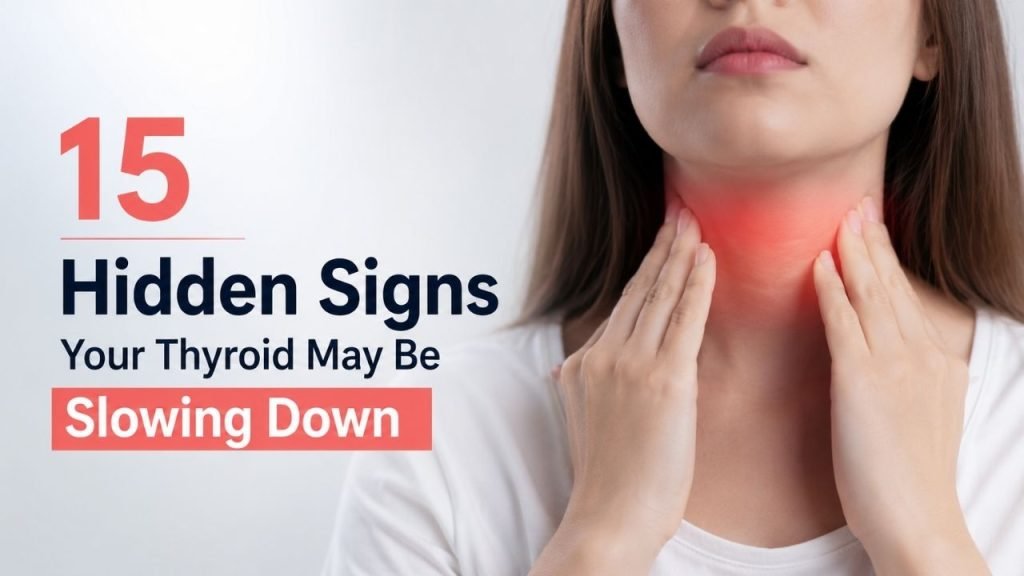
The thyroid is a small butterfly-shaped gland sitting at the base of your throat that most people never think about until something goes seriously wrong, yet it is quietly responsible for regulating nearly every major system in the body including metabolism, heart rate, body temperature, digestion, mood, skin health, and reproductive function. When the thyroid begins underperforming — a condition known as hypothyroidism — it does not announce itself with one obvious dramatic symptom; instead it sends a collection of subtle, easy-to-dismiss signals that most people spend years attributing to stress, aging, poor sleep, or simply not taking care of themselves well enough. The frustrating reality is that thyroid dysfunction is one of the most commonly missed diagnoses in modern medicine, particularly in women.
15 Hidden Signs Your Thyroid May Be Slowing Down :
1. Persistent fatigue that sleep does not fix
This is not ordinary tiredness at the end of a long day — it is a deep, heavy exhaustion that is present from the moment you wake up regardless of how many hours you slept, and that does not improve as the day goes on. When thyroid hormone levels drop, every cell in the body receives less stimulation to produce energy, which means the fatigue is systemic and total rather than localized to one area of life or activity.
2. Unexplained weight gain despite no change in diet
The thyroid directly controls metabolic rate, and when it slows down, the body burns fewer calories at rest and begins storing energy as fat even when food intake has not increased. This weight gain tends to be gradual — one to two kilograms per month — and is particularly frustrating because no amount of dietary restriction or increased exercise produces the expected results until the thyroid issue is identified and addressed. The weight also tends to distribute differently from lifestyle-related gain, appearing across the entire body rather than concentrating in one area.
3. Feeling cold all the time when others are comfortable
One of the thyroid’s primary roles is regulating body temperature by controlling the rate at which cells produce heat, and when thyroid hormone production drops, this thermoregulatory function weakens and the body consistently runs cooler than it should. People with hypothyroidism often find themselves wearing extra layers, keeping heating on higher than others in the same room prefer, and feeling a bone-deep coldness in their hands and feet that no amount of warming seems to fully resolve.
4. Brain fog and difficulty concentrating
The brain is one of the most thyroid-sensitive organs in the body, and low thyroid hormone levels directly impair cognitive processing speed, working memory, and the ability to concentrate on tasks that previously required no effort. People describe this as thinking through cotton wool — thoughts feel slow, words do not come easily, tasks that used to take minutes now take much longer, and there is a persistent feeling of mental dimness that is completely different from ordinary tiredness.
5. Hair thinning or excessive hair loss
Every hair follicle in the body requires adequate thyroid hormone to complete its normal growth cycle, and when levels drop the follicles shift prematurely into their resting phase, causing hair to shed faster than it is replaced and producing a gradual but noticeable thinning across the entire scalp rather than in patches. Unlike stress-related hair loss which tends to be temporary, thyroid-related hair loss continues as long as the hormone deficiency persists and can also affect eyebrows — particularly the outer third — which is considered one of the more specific physical signs of hypothyroidism.
6. Constipation that does not respond to dietary changes
Thyroid hormone is essential for maintaining the normal muscular contractions — called peristalsis — that move food through the digestive tract, and when levels fall, gut motility slows significantly, producing chronic constipation that persists even when fiber intake, hydration, and physical activity are all adequate. This is not the occasional constipation that resolves with a dietary adjustment — it is a persistent, ongoing sluggishness of the entire digestive system that is one of the earliest and most consistent gastrointestinal signs of an underactive thyroid.
7. Dry, rough, or pale skin
The skin requires thyroid hormone for normal cell turnover, sweat gland function, and collagen production, and when levels drop the skin becomes dry, rough, and slightly thickened in a way that moisturizers alone cannot fully address because the problem is coming from within rather than from external dehydration. Reduced sweating — another consequence of low thyroid function — means the skin loses one of its primary mechanisms for staying naturally moisturized, and the result is a persistent dryness that is particularly noticeable on the elbows, heels, and shins.
8. A slow or irregular heartbeat
Thyroid hormone has a direct stimulating effect on the heart, and when levels drop the heart rate slows in a way that can produce palpitations, a sensation of skipped beats, or simply an unusually low resting pulse that leaves people feeling sluggish and breathless with minimal exertion. This cardiac slowing is one of the more medically significant signs of hypothyroidism and can contribute to high blood pressure, elevated cholesterol, and increased cardiovascular risk when left unaddressed.
9. Muscle weakness, aches, and cramping
Low thyroid hormone impairs the ability of muscle fibers to contract and relax normally, leading to a generalized weakness that makes previously easy physical tasks feel disproportionately effortful, alongside aching and cramping that is often worst in the morning and after periods of inactivity. This muscle involvement in hypothyroidism is frequently mistaken for fibromyalgia, chronic fatigue syndrome, or simply the aches of aging, particularly in people over 40 who assume their body is just wearing out.
10. Depression or low mood without an obvious cause
Thyroid hormone plays a significant role in the production and regulation of serotonin and dopamine — the neurotransmitters most directly associated with mood, motivation, and emotional resilience — and when levels fall, the brain’s chemistry shifts in a way that can produce genuine depressive symptoms including persistent low mood, loss of interest in activities, emotional flatness, and a general withdrawal from life. What makes this particularly insidious is that thyroid-related depression responds poorly to antidepressant medication alone, and many people spend years cycling through different psychiatric treatments without improvement simply because the underlying hormonal cause has never been tested.
11. Puffy face, especially around the eyes
One of the distinctive physical signs of hypothyroidism is a puffiness or swelling of the face, particularly around the eyes and in the cheeks, caused by the accumulation of mucopolysaccharides — substances that attract and hold water in the skin and soft tissues when thyroid hormone levels are insufficient to clear them. This facial puffiness is different from ordinary water retention or allergic swelling — it tends to be consistent rather than coming and going, is not relieved by reducing salt intake or drinking more water, and often gives the face a somewhat heavy or swollen appearance that people attribute to weight gain or poor sleep.
12. Hoarse or changed voice
The thyroid gland sits directly adjacent to the larynx, and when it enlarges or when hypothyroidism causes the accumulation of mucinous material in the vocal cord tissues, the voice can become noticeably deeper, rougher, or huskier without any throat infection or obvious cause. Many people notice this as a gradual change over months — their voice simply sounds different, tires more easily during conversation, or loses its upper range — without connecting it to the thyroid sitting directly beneath.
13. High cholesterol that does not improve with diet
The liver uses thyroid hormone to regulate cholesterol metabolism, and when thyroid function drops, LDL cholesterol — the type associated with cardiovascular risk — rises even in people eating a genuinely healthy diet with low saturated fat intake. This is one of the most medically important but least recognized consequences of hypothyroidism, because elevated cholesterol in a person with undiagnosed thyroid disease will not respond adequately to dietary changes or even statin medication until the thyroid issue is treated. Anyone with persistently high LDL despite good dietary habits should have thyroid function included in their cardiovascular workup as a standard part of the investigation.
14. Irregular or heavier than normal menstrual periods
Thyroid hormone is deeply intertwined with the hormonal systems that regulate the menstrual cycle, and hypothyroidism frequently disrupts this balance in ways that produce heavier, more painful, more prolonged, or more irregular periods than a woman has previously experienced. In more significant cases it can cause cycles to become very frequent, very infrequent, or to stop altogether, and it is one of the more common hormonal causes of fertility difficulties that goes undetected because the connection between thyroid function and reproductive health is not widely understood by patients.
15. A feeling of swelling or tightness at the front of the throat
Some people with hypothyroidism develop a goiter — an enlargement of the thyroid gland itself that is visible or palpable as a swelling at the base of the throat — while others simply notice a persistent feeling of tightness, fullness, or mild pressure in the neck without visible swelling. This sensation can be subtle enough to be attributed to anxiety, acid reflux, or muscle tension, and many people live with it for years without connecting it to the gland sitting directly beneath the skin at the front of their neck.
Disclaimer:
This article is for informational purposes only and is not a substitute for professional medical advice, diagnosis, or treatment. If you recognize several of these symptoms in yourself, please consult a qualified healthcare provider and request a comprehensive thyroid panel including TSH, free T3, and free T4 before drawing any conclusions. Always seek guidance from a licensed medical professional for any personal health concerns.